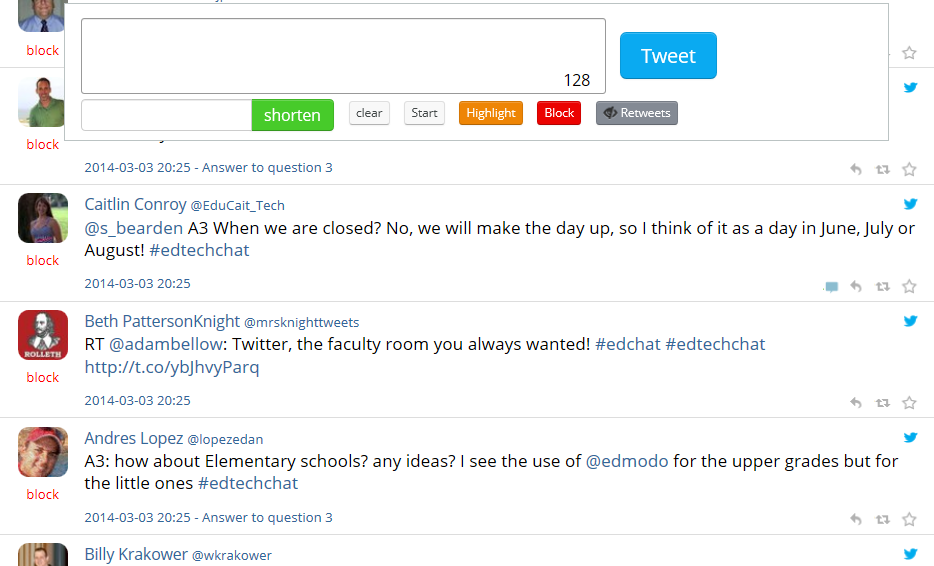
I joined a Twitterchat with
the hashtag #Edtechchat. When I entered the chat room, many people were already
started talking. Some of the members were new to this chat room just like me,
and they tweeted a brief introduction of them.
Before I joined his group, I
thought they talked the specific techniques about applying technology in the
classroom or something very academic. But later, I found that their first
question of the day was about the bad weather and school. I felt a little
surprised and breathed a sigh of relief. I didn’t feel nervous anymore because
I could say something about this topic. I studied in Buffalo where the cold
weather was everyday’s fare and snowing was routine.
However, a problem came
up. The limitation of each tweet was 128 characters, which was apparently long enough
for my reply. So I had to reorganize my sentence and chose shorter words
instead. At first, I thought this was a little bit annoying. Why should there
be a restriction on the letters? But a few seconds later, I told myself that
maybe the reason why it named “tweet”, a short, high sound. And I think I could
express myself clearly in short words. To be honest, it was interesting when
you have to struggling with the words. Maybe I will use “words limitation” in
my teaching for some writing tasks or word games. Furthermore, Twitterchat is a good place for quick ask and quick answer.
May be I could use it as a sample to make a similar Q&A responses board for
my students to let them ask and answer the questions of what they have learned.
And that is also convenient for me to monitor my students’ study.
All in all, Twitterchat
offers me a platform to communicate with other people who have the same or even
more knowledge than me. I can always learn new things from them, and the
internet tools can always bring me ideas to apply in real classroom.
Welcome to my Blog. It is a good platform for me to meet more people and learn new things. As a TESOL student, my blog will probably sharing things about English education, and other things I'm interested in and care about. At last, please feel free to write down whatever you want to say. I hope you like my blog.
Monday, March 3, 2014
Let's Tweet!
Twitter
has proven itself to be an interesting and useful tool for educators around the
globe. If being used appropriately in language teaching, students would learn
new knowledge and have fun at the same time. The Teacher’s Guide to Twitter suggests
four tips for teachers using Twitter. Briefly, they are creating it, connecting
it, sharing it and keeping it.
As a future teacher, I have an idea that using
Twitter to form a study group. I can give mu students four course-related
topics each week. And ask students to choose their interested group. After they
form the group, each member should share a link of related article and post
their comments on each others’ sharing. Then appointing one student to tweet a complete
review of all the members’ ideas and sharing it with the whole class. In this process,
students should first searching articles, and then selecting the appropriate one. Finally,
they should write down their feelings or opinions in correct sentence
structure. The main purpose of doing so is to improve students’ reading and writing
skills.
I also come up with three basic rules which are inspired by 10 Twitter MistakesYou Should Avoid. Even though there are no official instructions to teach students
how to use Twitter correctly, the teacher has the responsibility to remind
students what they could do and they’d better not do. 1. Do not randomly connect or share on your
Twitter without concrete motivation 2. Do not provide unfounded or unreliable information
on Twitter 3. Show respects to others’ sharing and comments.
To sum up, Twitter
is a wonderful assistant to support teaching outside the classroom, which is convenient
and low cost than many real books and teaching materials. Twitter will bring infinite
benefits to both teachers and learners only if we use it reasonably.
Monday, February 24, 2014
Learning from the Virtual Community
I joined in a Google Communities named English language learning.The creator of this community is a TESOL
certified English teacher with qualifications from Oxford Seminars. And this
community is created for people around the world who interested in learning the
English. You can feel free to post any questions you may have, the other
members of the community could help you to find the answer. This is a community
where people with all varying degrees of language proficiency can learn from
one another.
As a non-native speaker, I could learn a
lot of new knowledge and informations from this community, such as specific grammar point (Commonly Misused Adjectives in the English Language;
Rules in Using the Apostrophe), culture (Halloween experience in the USA), and using English in daily
life(Asking for directions).
On the other hand, as a future teacher,
all the information in this community could be my teaching materials in my
classroom. All the knowledge are there, clearly and systematically. What I need
to do is digest them first ,and then find an appropriate way to put them out
and teach to my student. For example, if
I am teaching adjectives and I want to enlarge my students’ vocabulary, I might
only use adjectives part (see the picture
on the left side, which is sited from my community) , because the verb part is
not related to my teaching plan and that is too much information for my
students to digest. The Learner of Today
George Siemens pointed out in his article,
Connectivism: ALearning Theory for the Digital Age, that the foundational principles of
knowledge has been changed and is growing exponentially. With the development
of technology and networks, the structures and the manners of learning are
changing, such as formal classroom to informal one, separate works to
cooperative works, or from a small group to a larger group. Seimens(2005)
declared that connections
between disparate ideas and fields can create new innovations. Thus, he present
a new theory as “connectivism”.
Then, what is connectivism? According to Seimens,
“connectivism is the integration of principles
explored by chaos, network, and complexity and self-organization theories.
Learning is a process that occurs within nebulous environments of shifting core
elements – not entirely under the control of the individual”. Moreover, in the
video What is Connectivism, “knowledge is networked and distributed, which is increasingly
aided by technology”. Based on this
idea, I’d like to describe the individual learner as the airport. The internet
is the airplane. And the knowledge and information that people learned from
others are the passengers of the airplane. Different airports send passengers
to different destinations through airplanes. In other words, the individual, as
the starting point, uses internet as a tool to exchange information and
knowledge with another individual. Gradually, each individual will form their
own routine and systemic social network.
To sum up, applying technology is the
trend of teaching and learning in the future. It is necessary for the learners to
cultivate an ability to synthesize and recognize the target knowledge from the
large amount of information and transfer them to own use.
Wednesday, February 19, 2014
Diigo or Scoop.it? That's a question
Both Scoop. it and Diigo are two great tools to
create, share, and annotate the websites that you like. They offer teachers a
platform to create or join a group and share knowledge with colleagues,
students, and others. But, if someone ask me which one is better, my answer
will definitely be “it depends”.
Here is a brief form I
made to compare Diigo and Scoop. it:As you can see in the form, neither Diigo nor Scoop. it is perfect to meet every requirement. Well, as far as I concerned, I would prefer to use Diigo. I really like the idea that you can highlight the information that you want. Because I have a habit to take notes, and underline the words or sentences while I am reading. This might make feel more comfortable to continue reading. And also Diigo is convenient for me to track down other articles from the whole collection. All in all, the one fits you is the best for you.
FYI: I am not very familiar with these two tools. If there are some uses I missed or misunderstood, please comment on my blog, and I will try to adjust my content. Thank you!Wednesday, February 12, 2014
Want Learners to be Self-Motivated? Internet Makes it Come True
Many pedagogical theories and studies showed that student will learn
better if they are being appropriately motivated. But what kind of teaching
approach or who can motivate students? Dose it suit everybody? After watching
two videos about future teaching through Internet, the answer should be learner
themselves.
The first one is Future LearningDocumentary. Video games was described as “powerful learning tools that have
ever been created” in the video. It is amazing that you can always notice that
no matter how old a person is, he or she will play the game again and again
until reach a higher score or even master the game. During the whole process,
the player completes the task independently and continuously. Furthermore, some
video games are designed to be relevant with daily life, and also usually
present it in a fun way. As a language learner, I want design a video game just
like The Sims Games which you have to live in the TL country to survive by communicating
with your neighbors, your friends, and your boss. If the player could use the
language and vocabulary correctly and appropriately, he might be a successful
businessman and rich otherwise he might get punched or lose his job. With the
development of science and technology, I hope my idea will come true some day.
Another video is A Vision of 21st Century Teachers. All
the teacher said nothing but holding a white board to show what they want to
say. I think this might indicate an image of future teacher. Just as the first
video has mentioned, when children are given the permission to the Internet,
there should also be an absence of teacher to let students to try to learn by themselves.
But by ‘absence’, I do not mean that teachers are unnecessary or disappear in the future. What teachers
need to do in the future is to give high quality orders and let computer to do
the basic works, which offers students an opportunity to explore the
information freely and independently.
To sum up, online resources are boundless
and powerful. Sometimes the teaching activities or materials might not be motivated enough for everyone in the class. But what if find a way to let students motivate themselves in a cyber-classroom? That would be easy to make students study spontaneously and have fun at the same time. Internet
tools such as blog, twitter, YouTube, will polish your teaching with fascinating
effects and surprising outcomes.
Sunday, February 2, 2014
Using Blogs to Meet Learning Standards
Interacting with others is an effective way
to learn language, and because of the power of Internet, interaction becomes more
and more convenient and interesting. Blog, as one of the popular internet
tools, allows people to share information and their thoughts with each other
whenever they want. Thus, as an English teacher in the future, I would love to
use blog to build a platform for my students to inspire and motivate each
other.
Language proficiency should be accomplished through four language domains: listening, speaking, reading, and writing. In the following, I will describe how blogs could be used in reading and writing.
Reading:
Before starting a new lesson, teachers
usually ask students to preview the texts. For example, the next paragraph is an
excerpt from Oxford English S1A (Shanghai Edition), Unit 2 Care for hair:
Choose a shampoo that suits your type of hair (i.e., oily, dry or normal hair). Apply it after wetting your hair with warm water. After shampooing, squeeze out the extra water."
In this paragraph “shampoo” , “conditioner”
and “squeeze” are new words. I could link pictures with new words to help
students remember the meaning and have a direct view of them. Besides, I could share links of some course-related reading materials or
videos, such as A Brief History of Hairdressing Salon, What Hairstyles Suit What Faces,Barber by Chaplin, etc. Blogs could help students to read the text
in a vivid and fun way.
Writing:
After reading the materials, I could ask
students to share their tips about how they take care of their hair. Or students
can draw(sketch-paint) their favorite hairstyle and other students can make comments. Writing skills can be improved gradually by commenting others' work. Furthermore, this could motivated students before they
learn the text, and helps me to make sure that everyone gets involved.
Based on American Council on the Teaching of Foreign Languages (ACTEL), 3 National Standards for Foreign Language Education could be met in blogging this way:
- Standard 1.1: Students engage in conversations, provide and obtain information, express feelings and emptions, and exchange opinions.
- Standard 3.1: Students reinforce and further their knowledge od other disciplines through the foreign language.
- Standard 5.1: Students use the language both between and beyond the school setting.
To
sum up, blogs can be used as a tool for students to communicate for social, intercultural
and instructional purposes based on school settings. Blogs can provide a comfortable
atmosphere to let everyone speak, and it is easy for teacher to keep in connect
with students even outside of class.
Subscribe to:
Posts (Atom)


